Showing posts with label Science. Show all posts

Monday, April 19, 2010

When Things Take the Place of People, Or How to Suppress the Truth In Unrighteousness pt. 2

A little while ago, I commented on an article by Al Mohler about the gender-neutral leanings of many universities in the United States today.  I suggested this was a clear case of exchanging the truth of God for a lie as we are told happens in Romans 1:18-32.  When people stop recognizing God's created order, even though it is plain to see we can tell they are suppressing the truth in their unrighteousness.

Well, add another example to the list!  Today, Robin Phillips of Signs of the Times, has found another way our society has decided to believe a lie.

The debate about global warming has been pretty heated for quite a while now.  Often I have wondered if proponents of the climate change phenomenon care more about the environment than people.  Well, it seems as though we have confirmation of this.  At least one global warming/enviro friendly person does care about trees and Mother Nature more than he does about his fellow man.

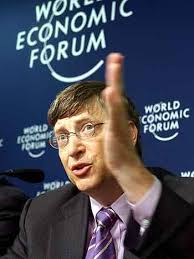
It seems as though Bill Gates has decided we need to decrease the human population, in order to ensure the survival of the planet.  In fact, he is advocating the use of vaccines to help achieve this goal!

I want to be clear, I recycle (sometimes because my wife makes me), I do care about the world we live in.  It seems clear to me we are supposed to be stewards of our environment.  This world is not ours to destroy, it is God's and he has asked us to rule over it (Genesis 1:28).

However, it is also clear humans are the epitome of the created order.  God has given us creation to rule over, which logically means we are greater.  A lesser cannot rule a greater!  It has been said, that one human being is worth more than all the molecules in all the universe.  This being so, we cannot stand by and watch as people suggest we are worth less than what God has said.  He created us in His image, and we must stand for the truth.

Sunday, April 11, 2010

A Post on the Kalam Cosmological Argument.

I am in the middle of a series on the cumulative case for the existence of God.  You can find the first post in this series here.  So far I have 5 different posts in the series, with I think 2 more to go.

For those who might want supplementary explanation on the Kalam Cosmological Argument (Part 2), Wintery Knight has posted an excellent article detailing the way science has strengthened the Kalam.

Wintery Knight is an excellent apologist, I hope you take the time to review his argument.

Monday, April 5, 2010

Kittens to Cats! Bacteria to Cats? Or a Great Example of Sleight of Hand

Denyse O'Leary at Uncommon Descent has written a fantastic article on one of my pet peeves when talking to Macro Evolutionists.

This pet peeve of mine is when Darwinists use obvious examples of micro evolution or even simple change as evidence for macro evolution, when a species evolves into a wholly new species. This tactic has been employed by Darwinists ever since Darwin used the micro evolution of changing finch beak size to explain the alleged macro evolution of the species.  This is not a new idea, but it is used often.  While on my recent trip to Berkeley with Stand to Reason I encountered a student  who defined becoming a new species as "when one group can no longer breed with another group."  Unfortunately, there are all sorts of reasons groups may no longer be able to interbreed.  This does not mean a fruit fly is no longer a fruit fly.

Anyway, O'Leary has written about this far better than I ever could.  He explains the criteria one scientist uses as evidence for macro evolution also occur in the changes in a kitten becoming a grown cat.  But a Kitten is a young cat!  This is no species change.  It is common change within a species. If a kitten can undergo these same changes as a simple bacteria, but still remain a feline, why would we assume the bacteria is now a new species? Clearly this criteria is not adequate to explain a change from species to species.

What bothers me the most about this is the dishonesty regarding this issue.  Macro-evolutionists either know this type of argument does not constitute species change, and thus willfully attempt to deceive the public, or they do not know about this problem, and thus are not doing their due diligence because they are deceived themselves.  Either way this is more an example of verbal sleight of hand than any true evidence.

If you would like a little more in depth analysis of this issue, check out this podcast, or read The Politically Incorrect Guide to Darwinism and Intelligent Design, chapters 3 and 4.  There are many more resources on this, but these are a good start.

Tuesday, March 30, 2010

It is reasonable to believe in God. Pt 4

In a previous post I argued for the existence of God based on the Teleological Argument.  Specifically, I used the argument for the Fine-Tuning (and therefore purpose or design) of the Universe.  But we may also use the Teleological argument in another way.
Life is Good, But It is Complicated
Similarly, to the Fine-Tuning Argument, one can also determine life could only arise because of the intelligence of some designer.  Not only can we determine the universe would be inhospitable to life without the intervention of intelligence, but life itself is so complicated as to need an intelligence creating it as well.  This is because even the most basic forms of life contain a lot of information.
If you went hiking on a mountain one day, and came across a pattern of rocks arranged in such a way as to spell, “welcome to the mountains,” what would you conclude?  There are only two options to explain this phenomenon, impersonal causation and personal causation.  In other words, either something natural caused the rocks to be arranged this way, or a person caused the rocks to be arranged this way.  Clearly, this is a product of intelligence.  Messages are a sign of intelligence.  Messages assume there is a a sender!  Even if no one receives the message an intelligence must send and compile the information.  Information cannot be the product of natural processes.
Life contains similar information.  The genetic code of DNA is like a novel.  “DNA has specified complexity in its message.” “Significantly, the nucleotide sequences in the coding regions of DNA have, by all accounts, a high information content--that is, they are both highly specified and complex, just like meaningful English sentences or functional lines of code in computer software (http://www.arn.org/docs/meyer/sm_dnaotherdesigns.htm).”  The code of DNA is very complicated, is arranged in a very specific way.
There is no such thing as simple life.  Even the simplest form of life contains a lot of information.  Even the amoeba has as much information in its DNA as 1,000 sets of the Encyclopedia!  If a simple message such as “welcome to the mountains” needs intelligence behind it, why would we not conclude that the equivalent of 1,000 encyclopedias of information needs intelligence?  “Mind or intelligent design is a necessary cause of an informative system, one can detect the past action of an intelligent cause from the presence of an information-intensive effect, even if the cause itself cannot be directly observed.”  All other forms of information are recognized as the product of intelligence, the information of life is no different.  The complexity of life can only be explained as the product of an intelligence, and this intelligence is much like God. 
Again, this is not conclusive evidence for the existence of God, but is instead another link in our chain, making the belief in God a viable option.
Next, The Moral Argument for the Existence of God

Monday, March 22, 2010

It is reasonable to believe in God. Pt 3

             I have been arguing for the viability of belief in God.  My previous post on the Kalam Cosmological Argument  argued the beginning of the universe is best believed to be caused by something outside the universe.  But how do we know the universe was caused by a designer?  Part of the answer to this question comes from another type of argument for God's existence: The Teleological Argument, or Argument from Design.  There are at least two forms of this argument, in this post I will focus on the argument from the design of the universe.
Designer Jeans and Designer Worlds
            Sometimes people will comment how much better clothing looks on the models that wear it than it does on themselves.  There is a good reason for this.  The designer has made the jeans to fit people who look just the models who wear it.  Unfortunately, not many people actually look like models.  In fact, it is much more probable that clothing should be made different from how it often is, because most people do not look like models.
            In the same way, the universe could be much different from how we observe it to be.  The universe could be hostile to life in so many ways.  Most of the possible configurations for the world are hostile to life.  However, this is not what we find.  Instead, we find the universe is strangely configured for the flourishing of life.  It is as though the universe , like designer jeans, was made for those who live in it. This argument is often called the Fine-Tuning of the Universe for Life.
What evidence is there that the universe was fine-tuned for life?  Many aspects of our universe must be very specific for the habitability of complex life.  There are at least 154 different environmental requirements that must fall “within narrowly defined ranges for physical life of any kind to exist.”  These environmental requirements are often called Anthropic Principles.  These principles must be very narrowly defined or life would be impossible.  Some examples of these principles are the force of gravity, the strong nuclear force, the weak nuclear force, the type of galaxy we live in and where we live in it, and even the size of Jupiter and our own moon.  All of these things must be exactly what we find them to be, or life would be impossible.
For example, if the force of gravity were changed even a little, the implications on life would be catastrophic.  If it “were altered by 0.00000000000000000000000000000000000001 percent our sun would not exist, and, therefore, neither would we.”  Similarly, if gravity were too strong the universe would have collapsed on itself during the Big Bang, but if gravity were too weak, planets, galaxies, and stars could not have formed as we know them.  We need gravity to act exactly as it does for life to be possible.
In the same way, even the size Jupiter creates an environment for life to be possible on earth.  If it the distance was greater too many asteroid and comet collisions would occur on Earth.  If the distance was less: Earth’s orbit would become unstable.
With at least 154 of these types of parameters, obviously the chance the universe could have just happened this way would be very low.  It has been calculated that the chance life would arise without an intelligent designer is less than 1 chance in 10282 (million trillion trillion trillion trillion trillion trillion trillion trillion trillion trillion trillion trillion trillion trillion trillion trillion trillion trillion trillion trillion trillion trillion trillion).  In other words, this is the chance that the universe could be the way that it is without a God creating the universe for a reason.  This is astounding considering there are only 1070 atoms in the entire universe.  In other words, the chance the universe just happened to be this way is effectively zero.  It would take an intelligence to create the universe in such a meticulous fashion.  God being omnipotent is able to produce a world orderly in these respects.  And he has good reason to choose to do so: a world containing human persons is a good thing.  The universe was intelligently designed for life.
Does this prove there is a God? Not 100%, but these arguments show it is reasonable. Next, the Teleological Argument pt. 2

Tuesday, March 16, 2010

Have No Fear Theists, the Big Bang Model is Here

In his article, A Beginner's-and Expert's-Guide to the Big Bang: Sifting Facts from FictionsHugh Ross explains why theists should not fear the implications of the Big Bang model for the origination of the universe.

Indeed, instead of fearing the Big Bang model, theists should embrace it.  The Big Bang model implies an "immensely powerful yet carefully planned and controlled release of matter, energy, space, and time within the strict confines of very carefully fine-tuned physical constants and laws which govern their behavior and interactions."  This kind of control and power implies a supernatural creator.

In fact, non-theists often try to disrepute the Big Bang model exactly because it has such theistic implications.

Christians would do well to not worry where there is no reason to worry.


Thursday, March 11, 2010

It is reasonable to believe in God. Pt 2

In one of my previous posts, I argued belief in God is rational, not provable. In fact, I believe that belief in God is more reasonable than disbelief given the evidence. This evidence is a cumulative case for the existence of God, not just one silver bullet argument. Instead, the arguments for the existence of God are more like a chain-link fence, stronger together than the parts are apart.
So is belief in God actually rational? The first link to build our fence is the Kalam Cosmological argument. This argument has been popularized recently by William Lane Craig. In logical form the argument goes like this:
1. 1. Everything that begins to exist has a cause
2. 2. The universe began to exist
3. 3. Therefore, the universe has a cause
The conclusion clearly follows from the premises. Therefore, if the premises are true, then the conclusion is sound.
But are the premises true?
Does Everything that Begins to Exist Have a Cause?
There are only two options for premise 1. First, everything that begins to exist has a cause, or there are some things that begin to exist which do not have a cause. But what would an uncaused beginning look like? Can you think of anything that has begun which did not have a cause? I can’t. In fact, it seems as though it is a brute fact, that things which begin to exist are caused.
There is only one major objection to this premise. Often, atheists will point to quantum physics as examples of things coming into existence uncaused or without reason.
I will admit quantum mechanics are very weird, but there is no evidence to suggest there is absolutely no cause for the things we observe in the quantum world. Energy fluctuations and other reasons for the causes of the quantum physical world are not only possible, but considering our limited knowledge of the quantum they are probable. In addition, quantum mechanics is still an unreliable source of any kind of information. It seems to be clutching at straws to appeal to this “science.”
So, the first premise seems to be true. Everything that begins to exist has a cause.
What about premise two?
How do we know if the universe began to exist?
There are two lines of evidence showing a beginning of the universe, Scientific and Philosophical. We will focus on the Scientific.
The Big Bang Theory. Virtually all astronomers and physicists now agree with the Big Bang Theory. Scientists have observed many lines of evidence for a Big Bang. Among these are the fact that the universe is expanding (which means it will get smaller if we went back in time), and the correct amount of background radiation consistent with what might have happened in an explosion at the beginning of the universe.
Also, the 2nd law of thermodynamics suggest the universe began to exist at some point. This law states any closed system will use up energy and eventually die a “heat death.” At this point in time we have not yet run out of energy, meaning there is still energy to use. This shows us the universe cannot be eternal. If it was eternal, the universe would have gone through an infinite amount of time to reach the current point in time. This means the universe would have run out of energy. However, because we haven’t run out of energy, this means there has not yet been enough time to use it all up, suggesting a starting point.
Now, one objection to this evidence from the 2nd law of thermodynamics is to speculate the universe might not be a closed system. If this was the case, then the universe could draw upon an outside force for more energy. However, there is no compelling reason to believe in such an outside force feeding the universe, and if it was true, this “source” would be dangerously close to the definition of God, being before time, spaceless, immaterial, powerful, etc. Also, the above evidence for the Big Bang, is suggestive to reach the simplest conclusion about energy in the universe, which is that energy is being used up.
These lines of evidence, and others, are suggestive to believing the universe did have a beginning.
But what does that prove?
The Universe Had a Cause
The above premises logically lead to the conclusion, the universe had a cause. Does this prove God? Could the cause be something other than God? It could, but one must remember this cause must be timeless, spaceless, immaterial, powerful, etc. These qualities are much like the definition of God of the Bible. We do not yet know if the God of the Bible is the cause of the universe, but whatever the cause, it is consistent with this definition of God.
This argument does not prove the existence of God 100%, but it is good evidence leading to that conclusion. If we can find other, independent lines of evidence, we can make the case even stronger.
Thursday, July 16, 2009

We are on the Moon!


On July 16th, 1969, two United States astronauts began a journey to finally land on the moon. This was one of the most remarkable and important events of the 20th century.

We began to conquer space... Science was believed to be able to solve all of man's problems. If we can only understand the physical world, we can harness it and bend it to our will. Even our amusement parks resembled our optimism in the Scientific universe.

When Tomorrowland was first created, Walt Disney tried to show the possibilities of science, and Tomorrowland was made to look futuristic, and optimistic. It was a tribute to the ingenuity of man. Man would be traveling at light-speed, and never want for anything!

40 years later, much is better, but much is worse. Conquering space did not solve humanity's problems. Neither did the rest of Science. In fact, Science has actually created some more problems. For those who held to Science, many stopped being able to find meaning. An unhealthy dependence on the promises of Science actually brought a sense of anguish, because many people believed the natural world was all that exists. This meant to these people there was no heaven, no supernatural, no life after death. When we die, we die.

Science has lost credibility to the "postmodern" mind. Even the development of Disneyland shows our general lack of faith in Science now.

Go visit Disneyland today... much has changed. Tomorrowland does not seem optimistic anymore. Instead it resembles more cartoon or sci-fi worlds than anything actually attainable. This metamorphosis in Disneyland has closely paralleled the general public's trust of Science. People no longer trust Science. When Science stopped being able to give meaning, people have moved to despair.

We have "conquered" the moon, but we have lost our confidence. Today is a great opportunity for Christianity to be a beacon of renewed hope. In a world searching for meaning, because Science has taken meaning of existence and obliterated it, Christianity can give true hope. Using the Scriptural example of showing reasons for our hope (I Peter 3:15), Christians can be light in a dark world.